top of page

By Dr. Harry Bloom, Founder and President, Benchmarking for Good, Inc.


A MAJORITY OF CURRENT DAY SCHOOL FACULTY MEMBERS ARE RELATIVELY LONG TENURED IN THE PROFESSION 

An analysis of the total teaching tenure of current faculty members indicates that about half have been teaching for more than 15 years. Further, another 17% for between 11 and 15 years. On the positive side it is comforting to know that highly experienced and skilled faculty members are fulfilling the educational needs of their students. On the flip side, however, overall faculty attrition rates are climbing and retirement rates will likely do so given the seniority of current faculty. Simply replacing these veterans will represent a major challenge given competition from public schools, which generally pay more and have better benefit packages, and even more lucrative private sector employment options. But that is not the only challenge our research has revealed.


THE RETENTION OF SHORTER TENURE FACULTY MEMBERS IS AT RISK

Benchmarking for Good’s faculty climate survey research among less experienced faculty members, who represent the future of the profession, indicates that they are significantly less satisfied with their jobs than their more senior colleagues and less likely to recommend that friends or family members work for their school.


WHY ARE SHORTER TENURED FACULTY LESS LIKELY TO PROMOTE THEIR PROFESSION?

The issues that diminish these less experienced teachers’ willingness to recommend employment at their school are illustrated by the following comments and suggestions from survey respondents:


“Be transparent about salaries, and offer a real path for growth in this sense as well.”

“It's upsetting that improving salaries of teachers is a long term goal and not a short term goal. That's a HUGE reason why people leave or think about leaving and I think finding immediate ways to improve teacher salaries is a big way to make the school an employer of choice.”


“ More professional development opportunities is also a big draw because it's an investment in your professional growth. I also would like to know what opportunities for growth there are as a teacher here, especially as I reach my 5 years here and don't want to get bored.”

“Better benefits (tuition remission, etc.), PTO, opportunities for growth, 401k matching.”

“Have clearer expectations for teachable standards at each grade level and monitor and support teachers in delivering said instruction.”

“Support the staff and see us as equals; demand and ensure respect from the students and parents; treat us like adults and take our concerns seriously - listen to us as if we are experts in the field and experienced professionals who are in the classrooms daily; provide more re.”

“I would like more encouragement and positive feedback from the administration. I feel under-appreciated.”


In summary: low salary levels and an absence of salary transparency, inadequate professional development and the lack of perceived growth opportunities, unclear expectations, and lack of perceived appreciation represent satisfaction detractors for less experienced faculty members. 


A CLEAR CALL TO ACTION FOR SCHOOL LEADERS 

The implications of these findings from Benchmarking for Good’s faculty climate and benchmarking research are clear. Yes, it is important for school leaders to focus on retaining their veteran faculty members and replacing them with capable substitutes as they retire. However, in order to reliably secure the future of quality education they also need to be in serious dialog with less senior faculty members about their legitimate complaints and then be prepared to act on that dialog by creating strategic action plans to meet reasonable requests. 


The challenge is clear and the response needs to be equally clear. 


ENGAGE WITH BENCHMARKING FOR GOOD AND ITS NO COST SERVICES FOR APPROVED GRANTEES

To learn more about how Benchmarking for Good’s research and benchmarking analysis and Grant programs can help your school confront its challenges please contact Dr. Harry Bloom at harrybloom@benchmarkingforgood.org


        #faculty retention   #teaching excellence  #Supervision   #Professional development


Updated: Apr 9, 2024

By Dr. Harry Bloom, Founder and President, Benchmarking for Good, Inc.


Faculty Climate Survey Findings

Based on recent Benchmarking for Good faculty climate surveys with 800 educators working in over a dozen diverse Jewish day schools, several schools stood out in terms of the higher propensity of their faculty to recommend them as employers of choice to friends and colleagues. The highest performing schools include the Donna Klein Jewish Academy (Boca Raton, FL), Ida Crown Jewish Academy (Chicago, IL), and Fuchs Mizrachi Day School (Cleveland, OH). 


Of note, the top performing schools on Employer of Choice-related metrics were not distinguished from their peers on the dimension of salary and benefits. However, they did set themselves apart on three other factors: (1) perceived performance in work/life balance, (2) realistic supervisor expectations about workload, and (3) providing supportive tools (e.g., in the form of space, curriculum and technology). 


Implications for School Leaders

In a tight employment market for qualified teachers, senior school administrators would do well to learn more about the factors that turn faculty members into promoters via faculty climate surveys, and related qualitative research. A great place to start is actively delving into the work/life balance flexibility faculty seek, about what gives them clarity and comfort relative to workload expectations, and about the tools that make them feel supported in their profession. 


In a competitive job market, this type of research and the findings it generates could mean the difference between your school being successful in retaining current faculty and hiring new ones, and the reverse.


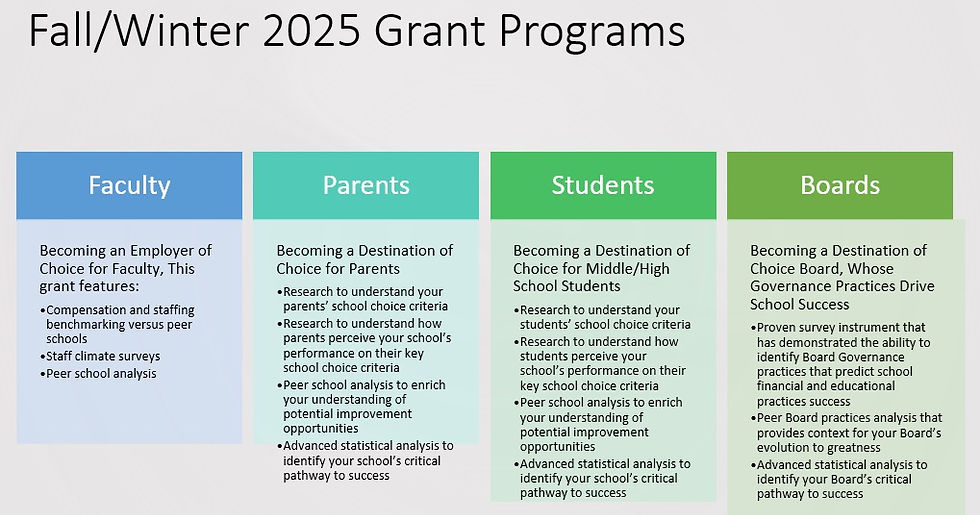
For more information about Benchmarking for Good’s grant programs in support of positive faculty climate, please contact Dr. Harry Bloom at harrybloom@benchmarkingforgood.org.


#faculty climate  #supervision  #edtech  #work/life balance  #classroom 


By Dr. Harry Bloom, Founder and President, Benchmarking for Good, Inc.


As the economy begins to slow down due to higher interest rates that hinder job and wage growth, it is more important than ever for leaders to determine their organization's market potential and identify--via targetable lists-- its optimal prospects. Yet, this step is often overlooked, or underwhelmed in the process of developing enrollment management plans. The result is “hit or miss” enrollment management programs that aim relatively blindly.


I learned the value of bringing strategic and operational rigor to the “Know Thy Customer” process during my formative years as a Brand Manager at Procter & Gamble “University,” and never forgot this critical lesson. Not knowing your school's actual market potential is akin to playing a sport without knowing how to win!


The “we want to pull out all the stops” enrollment management team will recognize that there are two pathways to data driven prospecting and that these pathways complement each other. That is because each pathway enables a different kind of marketing rigor to be brought to bear, yielding more certain gains. The two pathways are Market Segment Identification and Individual Prime Prospect Identification.


Market Segment Based Prospect Identification 

This prospecting approach involves creatively assessing your parent/student body and identifying underlying, targetable market segments based on discernible social networks. Once this is done it will be possible to assess the enrollment potential of each of those segments for your particular institution and to establish concrete market share targets for each segment. Knowledge of the market segments offering the best opportunities for growth enables a school to employ its most potent enrollment management weapon with great effect: Ambassadorship. Parent, Student and Faculty ambassador programs that generate word of mouth advocacy within market segments enable a school to have a veritable army working against key segments on its behalf.


Individual Family Prime Prospect Identification

This approach entails using Big Data to study the individual demographic characteristics of your families and then mine the universe of families for “more like them” targets. In essence this is what social media companies like Meta and Google attempt to do for millions of clients. But a school has the choice of relying of social media companies to do its prospecting for them or to work to master its own approach to this task. The value of a school working at this on its own is that it can actually own a prospect list, perform marketing experiments and become a learning organization that constantly improves its ability to manage its market. Leaving the job to the social media companies means only seeing the fringe of the market: those who have responded–and missing those who have not yet done so and not having the opportunity to learn why they did not respond.


In Summary

Thoughtfully choosing how it will go about prospecting for prime prospects is one of the most important strategic decisions a membership organization can make. Ensuring your organization's prospecting strategy decisions are made after a careful data-driven consideration of (a) all the options and (b) the costs versus benefits is key to success and should involve senior leadership at the highest levels of the organization.


To learn more about how your school and its network can maximize enrollment using this two pronged approach please contact Dr. Harry Bloom at harrybloom@benchmarkingforgood.org


# market segmentation    #Big Data   #demographic analysis    #strategic planning


bottom of page